
Reaching for a high shelf, putting on a jacket or fastening a seatbelt should be easy. When the shoulder hurts, these everyday movements become frustrating — and sleeping on that side can become impossible.
Two common causes of a painful shoulder are rotator cuff problems and frozen shoulder. They can feel similar at the start, but they behave differently.
Rotator cuff problems
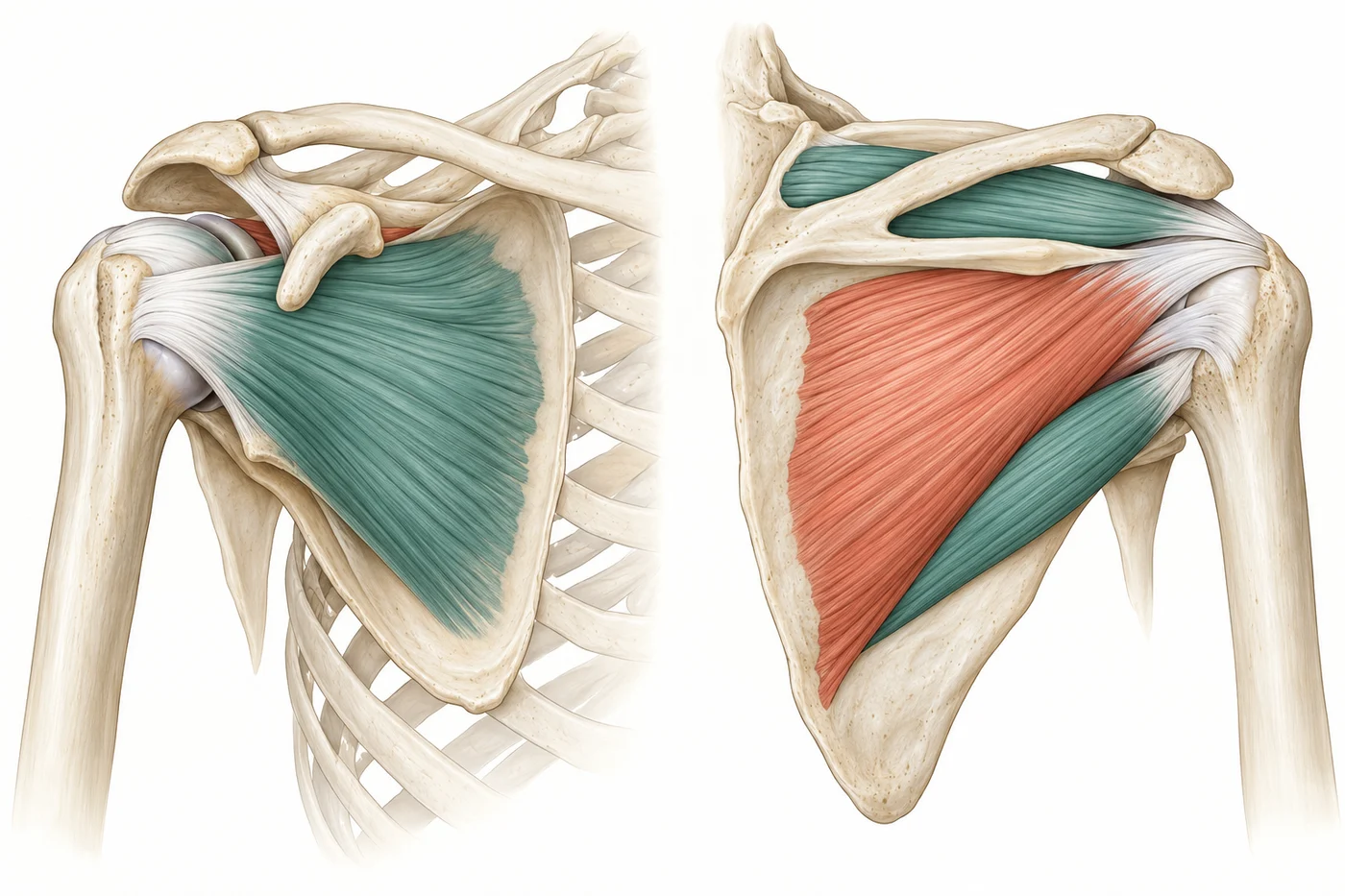
The rotator cuff is a group of four small muscles and their tendons that keep the ball of the upper arm centred in the shoulder socket while you move. Overuse, repeated overhead work, sport or a fall can irritate or strain these tendons.
Typical signs:
- pain on the front or outside of the shoulder, sometimes down the upper arm,
- pain in a certain part of the movement, for example when lifting the arm sideways,
- the shoulder still moves, especially if someone else lifts your arm for you,
- weakness when lifting or rotating the arm.
Frozen shoulder
A frozen shoulder (adhesive capsulitis) happens when the capsule around the shoulder joint becomes inflamed, then thickens and tightens. It is more common between 40 and 60 and in people with diabetes.
Typical signs:
- the shoulder becomes stiff in every direction, not only painful,
- even when someone else tries to lift your arm, it will not go further,
- it often develops in stages: painful, then stiff (“frozen”), then slowly “thawing”,
- it can last many months.
The quick difference
| Rotator cuff | Frozen shoulder | |
|---|---|---|
| Main problem | Pain and weakness | Pain and stiffness |
| Movement when someone else lifts the arm | Usually much better | Also limited |
| Onset | Often after overuse or a strain | Often gradual, without a clear cause |
This table is a guide, not a diagnosis. A proper assessment — and sometimes imaging — is needed to be sure.
See a doctor first if
- you cannot lift your arm at all after a fall or injury,
- the shoulder looks deformed or you suspect a dislocation,
- you have chest pain, shortness of breath or pain spreading to the jaw (call emergency services),
- the shoulder is red, hot and swollen, or you have a fever.
What you can do
- Keep the shoulder moving within a comfortable range; complete rest makes stiffness worse.
- Avoid painful overhead activity for a while.
- Heat can help relax the muscles around the shoulder.
- Gentle exercises as advised by a doctor or physiotherapist.
How therapy can help
Manual therapy can reduce tension in the muscles around the shoulder and help the joint move more comfortably. At Garuda Massage we treat the shoulder as part of a system: the shoulder itself, the upper back, the chest and the arm.
Rotator cuff complaints often respond within a few sessions. A frozen shoulder takes longer; therapy aims to make movement easier and more comfortable while the condition runs its course.
References
- NHS — Frozen shoulder: https://www.nhs.uk/conditions/frozen-shoulder/
- NHS — Shoulder pain: https://www.nhs.uk/conditions/shoulder-pain/