
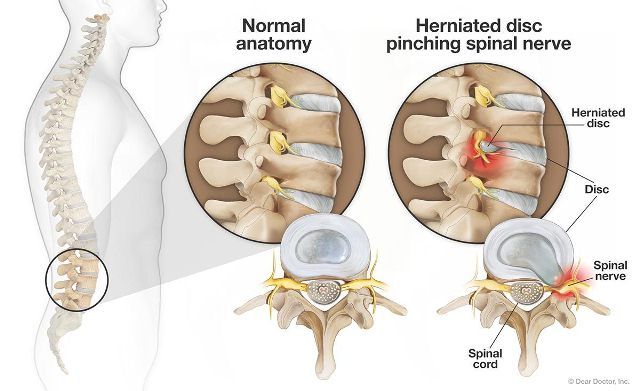
If you have seen a doctor in Indonesia about back and leg pain, you may have heard the words “saraf kejepit” (pinched nerve) or “HNP” (hernia nukleus pulposus — a slipped or herniated disc). These terms are related, but not exactly the same.
Sciatica: the symptom
Sciatica is pain caused by irritation of the sciatic nerve, which runs from the lower back through the buttock and down the back of the leg. Typical signs are:
- pain in the buttock that travels down one leg, sometimes into the foot,
- leg pain that is often worse than the back pain,
- tingling, pins and needles or numbness in the leg or foot,
- pain that gets worse when sitting, coughing or sneezing.
Slipped disc (HNP): one possible cause
Between the bones of the spine are discs that act as cushions. When part of the disc bulges or pushes out, it can press on a nearby nerve. That is a slipped disc, or HNP in Indonesian medical language. It is one of the most common causes of sciatica, but not the only one.
Sciatica-like pain can also come from tight muscles deep in the buttock (sometimes called piriformis syndrome), from narrowing of the spinal canal, or from other conditions. This is why a careful assessment matters.
The good news
Most episodes of sciatica improve within a few weeks to a few months without surgery. Staying as active as you comfortably can is generally better than resting in bed.
Seek urgent medical help if
- you have numbness around the genitals, buttocks or inner thighs,
- you cannot control or pass urine or stools,
- you have weakness in a leg or foot, or a “dropping” foot,
- symptoms are in both legs,
- pain follows a serious fall or accident, or comes with fever.
These can be signs of serious nerve compression (cauda equina syndrome) and need emergency care.
What helps
- Keep moving gently — short walks, changing position often.
- Avoid long periods of sitting, especially in a car.
- Heat or cold, whichever feels better.
- Pain relief as advised by a doctor or pharmacist.
- Exercises recommended by a doctor or physiotherapist once the worst has settled.
How manual therapy may help
Massage does not “push a disc back in”. What it can do, when there are no warning signs, is reduce the muscle tension and guarding that often build up around an irritated nerve, and help you move more comfortably.
At Garuda Massage, a pinched-nerve session (about 60 minutes) usually includes:
- a careful assessment of your symptoms and medical history — bring any MRI report if you have one,
- treatment of the lower back, buttock and leg muscles, adjusted to how sensitive the area is,
- advice on positions and activity between sessions.
We do not treat during a very acute flare with severe pain, and we will refer you to a doctor if your symptoms suggest it. Improvement is usually gradual over several sessions.
References
- NHS — Sciatica: https://www.nhs.uk/conditions/sciatica/
- NHS — Slipped disc: https://www.nhs.uk/conditions/slipped-disc/
- NHS — Back pain: https://www.nhs.uk/conditions/back-pain/